Showing posts with label Chinese culture. Show all posts

Friday, April 20, 2007

No rice!

After a good solid meal of ten "lamb-on-a-stick"s and four "duck-heart-on-a-stick"s, something to soak up the meat is often good. This being China, a simple bowl of rice seemed the best and easiest option. So, in search of this basic staple, I went into a nearby restaurant, where a few people were being served food.

The conversation went as follows:

"Could I have a bowl of rice please?"
"Don't have it."

Stunned silence..

"This is a Chinese restaurant, right?"
"Correct."
"I'd really like some rice."
"Don't have it."


By this time, I'd noticed a large bowl of steaming rice on one of the tables. Pointing to it, I ventured:

"Really? I can see the rice on that table. Can I have a bowl of that?"

The owner's look was rather grumpy at this point.

"Takeaway?"
"Fine."

So she stormed off, fetching my food. She didn't offer a single word for the rest of the transaction.


I've come across two possible explanations for this strange behaviour:
1. She was brought up to dislike foreigners ("white devils").
2. She didn't want me to occupy a table in her almost-empty restaurant for such a low fee.
Surely it's rather more important to grant someone a single bowl of rice, though! As for her lying, that's pretty much a part of modern life. Telling a lie - in daily life or as part of business - isn't really so much of a big deal.

Monday, March 12, 2007

First Date

Today I held a lesson on first dates.

This kind of topic is bound to result in some kind of awkwardness among Chinese students. The minimum age for marriage here is 22 for men and 20 for women, and I'd estimate that around 80% to 90% of my first- and second- year university students are virgins. Half of the younger generation still holds traditional values of no sex before marriage; the other half is adamant that it does not!

Even middle schools have rules such as "don't fall in love" (as well as "don't hold birthday parties" and "don't form a clique"). Making kissy noises is still a fantastic way of cracking the class up and embarrassing any poor victims (aka students) who happen to be showing affection toward members of the opposite sex. Making the students sit boy-girl-boy-girl works wonders for making them concentrate on the class; they're too embarrassed to do anything else! I try to break down this gender barrier as much as possible - after all, Mao Zedong stated women should be treated as equal to men, so I'm not worried about repercussions - it's annoying how it's even noticeable!

Anyway, back to this morning. When brainstorming for words and phrases about "A first date", interesting suggestions came back. As well as the usual stuff that you'd expect - "romantic, shy, exciting, nervous" and so on - there were things like "worried about money" (fair), "expecting to receive a gift" (fair, although only girls thought this mattered) "expecting a kiss" (this just from the boys) which were a little off the beaten track.

Then we had the good ones. "Morose" was listed, and apparently means, "when the girl is not satisfied after the date"; also, with an utterly serious and deadpan face, a small academic-looking girl ventured the idea that a first date may be "sweaty".

Dirty!

Sunday, March 11, 2007

Military training

All Chinese university students have the first 4-6 weeks of their tuition off from lessons. Instead, they are trained by the Chinese army, using university ground and facilities. Uniforms are provided, as well as weapons. Training begins at around 7.00-7.30am, and finished at 5pm, with an hour or two for funch. Training activities include, in no particular order: marching on the spot, sitting in a grid on the ground for two hours, sweating, rifle usage, marching backwards, and my favourite, breaking from marching in formation into a disorderly rabble of 18 year old students.

My first impression was that this was really unusual - education and "defence" are usually considered fairly separate activities in the cultures I've previously seen. Indeed, often there at odds with each other - you can either get educated, or failing that, maybe go into the military! Here, you may miss military training if you don't get into university (which is incredibly hard here). Even first-year Finance students have military theory lessons. However, China manages to allocate a lot less than some countries to defence - officially 1.35% of GDP, and unofficial guesses say no higher than 3%.

The whole process (compulsory for both men and women) is conducted under a roasting early September sun, and fainting girls are not uncommon. As with every school, it usually takes about 4 other girls to accompany a fainting one to water, and for boy, at least 2 extra are required. Students don't really state much of an opinion on military training. The whole process culminates in a weekend parade in front of higher-ranking officers.

Without further ado - pictures and videos!

Repurposed playing field:


Getting into formation - there must be hundreds of students on this small field:


Military is in green, watch out for jeans and adidas trainers:


Rifle practice:


Very pointy toes:


Walking backwards, and girls in a separate group:


Turn into a rabble:

Monday, February 26, 2007

Chinese lunch break

The Chinese also have a saying about the importance of lunch as the main source of energy in a day: "早餐吃得好,中餐吃得饱,晚餐吃得少" (at breakfast eat well, at lunch eat until full, [and] at dinner eat just a little).

The strangest thing happened when I first arrived here (and still does, every day): everybody in the office stopped doing everything at around 11.45, and ate (not too strange..), but when I looked around at 1.30pm, everyone was alseep! There's even a sofa-bed next to the desks, for napping on. Often three of the girls cram onto it at once and snooze their way to the afternoon lessons; if they have no lessons, having completed any marking or preparation, my colleagues simply sleep their way through the day at their desks.

It's said that the 2-hour lunch break originates from an Emperor who simply didn't have enough time to eat food and sleep during his day. Thinking that most of the rest of China had a similar problem, a 2-hour lunch break was decreed for the whole of China, and is still well observed to this day! More practical reasons can be found for this long break, though, which is reminiscent of southern Europe's siesta. This article about workers at a metal factory says:
They, themselves, start at 8 a.m. and work until noon, when there is a lunch break - 3 hours during the summer and 2 hours during the winter. They don't always go home for the lunch break. Often they stay at the plant, where they can heat the lunch they have brought with them. Work finishes at 5 p.m. in the winter and at 6 p.m. in the summer. The long lunch break is there for a good reason during the summer, when the moist heat does not further productivity - especially not in the middle of the day.


Of course, this elongated gap changes the amount of time you spend at work. While in Europe it's fairly common to start work around 9am, have what works out as 25-40 minutes of completely free time at lunch, and wind down as the clock approaches 5pm, here people are up very early and at their desks by 8am sharp, then work for four hours until 12pm, when they have a long lunch; relaxed afternoons take up the rest of the day until 5pm, when it's time to start going home. I think I prefer going in and getting the job done all in one go, then getting back to "real life" - being at the office (and its contingent of sleeping people) is not what you'd term quality time!

It's not just lunchtime that's good for a doze, though. Anywhere out of downtown, shopkeepers will open up early and simply nap (possibly in front of the TV, or maybe in the sun, open-mouthed and dangling off a chair) until a customer gets close enough to warrant a grunt or some kind of rousal. They do work very long hours - but they're mainly spent sleeping!

Monday, February 12, 2007

Busy Fuzi Miao

Busy Fuzi Miao
Busy Fuzi Miao

Fuzi Miao gets busy! This is just a Tuesday afternoon. The population here is immense, so much so that almost every business seems to succeed, no matter how much or little it's advertised - there are simply so many people going past that sooner or later, enough of them will provide some income. The Chinese seem to have a much reduced sense of personal space - probably as a direct result of the huge numbers of people trying to do anything. You can either stand back and miss an opportunity but retain free space around yourself, or sacrifice it and stand a chance in the rat race. I love it!

Sunday, October 01, 2006

Bicycles

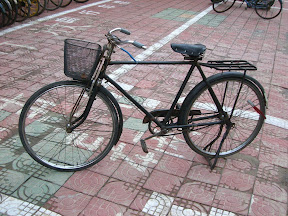
Everybody in China has a bicycle. Mine's a model that was popular about 25 years ago, it's black, built very strongly, and feels like it's made of cast iron.


Ace bike! This one will beat a Volvo


They use to be called "Weight Plus" because they'll take a lot of weight. You'll often see people with two metre stacks of boxes piled onto the backs of their bikes, wobbling through the streets! Most roads have wide cycle lanes, and they need it - it's not unusual to see a queue of forty bikes waiting at the traffic lights. Rules for cyclists are even less obeyed than those for motorists - the only one you should watch out for is to leave space for people turning right. Every bike has a registration number, as well as every moped, and driving without this is an offence. You can remove a strip of plastic from the middle of the registration plate, and most people do, though I've no idea why!

Electric bikes are popular, as are ones with very small petrol engines. The electric ones are usually pretty slow and I like overtaking them. In fact, Chinese cyclists tend to go at around double walking pace, which is really slow! It stops you sweating, and 10 years ago it might've been necessary because of the amount of bike traffic, but nowadays there's no need. Getting places takes a lot of time here, so I'm more than happy to go quickly! None of the bikes have gears, and although most of the world's bikes are made in China and good bikes are cheap, the theft risk is quite high for a nice mountain bike, and besides, I'd go much too fast to have a passable survival rate.

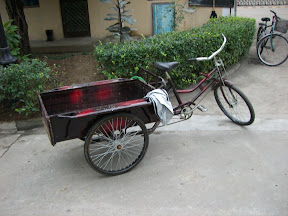
One particular type of bike that's popular with people who carry a lot of stuff around looks like a tricycle, and has a big box on the back. You can get varying sizes of box. I want one! You could get so much more in there than you can in the basket on the front - even a whole passenger - talk about luxury transportation..

Very new looking tricycle, for carrying stuff around.


Driving in China

Although there are many traffic rules and regulations in China, and the roads are wide, well-surfaced and laned, the actual driving experience is pretty much total chaos. Cars are fairly recent and up until about 3 years ago everyone had bikes, so they drive like cyclists - very aggressively, and into any space they'll fit! It's pretty good fun getting an "insane" taxi driver who's more than happy to drive full pelt towards oncoming traffic (in their lane) just to skip past the queue. My favourite manouveur is crossing at a crossroads or t-junction when the lights are red, by driving over a pedestrian crossing.


It's also amazing how close people drive to each other! There's no concept of personal space, which seems fairly reasonable, after all, there are a lot of people here, and personal space isn't actually used for anything much, is it? It carries through into driving, where squeezing three cars into two lanes is completely normal, and undertaking a bus while going round a sharp corner only warrants praise.


Chinese drivers use the horn as one might use a bicycle bell - to warn people that you're approaching. Mirror usage is pretty much unheard of; listening for horns coming from behind is usually enough. As a consequence, the roads are noisy, but it's not people being angry, it's perfectly routine!


As in Italy, if you want to cross the road, or go in front of somebody, and they're not going too fast, just walk out. The chances are, you'll get beeped at, but never hit. Accidents are surprisingly rare, which leads me to think that the Chinese are, on the whole, very good drivers!


For a city that had almost no roads in 1990, Nanjing's developing hugely quickly. Roads with fewer than seven lanes are only marked as "minor" on the city map! Also, right, the traffic lights have this well good thing, where there's a big sign counting down the seconds until when the light changes. Not only does it tell you whether you need to brake for them, it stops people getting irate at lights that seem to be on forever, and gives you something to look at while you wait! This is still the best idea I've seen since I got here, it's just wicked, everybody should do it. China's infrastructure is so thoroughly well developed. They really plan their capacity too - there are many enormous roads leading to areas of nothing, where land has been zoned for future construction. There's a whole highway that's completely empty in the northeast of Nanjing, just lying in wait for when all the building work there is complete (most of the land isn't even sold yet!)