Wednesday, February 28, 2007

Infrastructure

China's enormous. All the cities are massive. People refer to a town of one or two million as "small". This kind of population requires a fantastic transport system, and the powers hat be are well aware; massive areas to the north, south and east of Nanjing (there's a river to the west) are mainly incomplete, but already have a complex and advanced system of wide roads ready to take all the traffic produced when these areas are complete.

But that's not enough. The city centre is also under constant developement, and needs an infrastructure to match. As a result, new highways and high speed roads have been built to provide direct links for popular journeys. Where this isn't possible, tunnels are dug to connect highways and busy traffic centres. Since we've been here, a new 8-lane road has opened cutting north/south through the south east part of the city, which connects up to the end of Longpanzhonglu (lu, 路, being Chinese for "road"), a link to a major flyover just south of the city walls. And as if this wasn't enough, a tunnel is being dug underneath this new road, to be finished in February 2007. Hopefully this should relieve traffic flow in the south-east of the city!

It's interesting to see that the municipal authorities have no problems issuing orders for major roads to be built in already busy urban areas, despite the disruption it will cause. The sooner it's started, the sooner it should be finished, and people are expected to work around any problems - there's certainly enough alternative routes for most journeys, though they can become very convoluted. In December 2006, I took a taxi round the outskirts of the city, for about 20km, as the two main conventional ways of getting back into the city were blocked as a result of accidents in heavy fog at two already overladen junctions. Incidentally, one of these junctions has already been 'fixed' (as of mid-January) and is now a working twelve lane highway/tunnel intersection - they've built a 6-lane tunnel by the yellow square and following the yellow line to help transport traffic straight through the city centre.


Here are some shots of a nearby junction. I go along this route every morning (at about 7.30am, uurgh) as part of a commute to the remote campus of my uni, which is in Jiangning the new region of town to the South.
P1040120pp
P1040121pp
P1040122pp
P1040123pp

Also an aerial view. The photos document approaching from the left, looking south. The raised road going that looks horizontal is about 40m-60m above the ground (pretty high). - it's never very busy, but the area it leads to is still developing. It's much better to build the road before there's a traffic problem!

Nanjing Longpanzhonglu

Click to see the relevant area on Google maps.

Monday, February 26, 2007

Cute tricks with chicks

The chicks are growing! They love to sit by anything warm, as they're used to keeping hot beneath their mother. We've called them Soup and Curry. Chickens - even newly hatched baby chickens - peck at the ground constantly; as soon as one of them find something, the other runs over. So, if you tap on the floor lightly, like a beak pecking, they'll hear and run. (Press the play button in the bottom-left of the video to get it going quickly)


Once you've got their attention they won't let go!

Chinese lunch break

The Chinese also have a saying about the importance of lunch as the main source of energy in a day: "早餐吃得好,中餐吃得饱,晚餐吃得少" (at breakfast eat well, at lunch eat until full, [and] at dinner eat just a little).

The strangest thing happened when I first arrived here (and still does, every day): everybody in the office stopped doing everything at around 11.45, and ate (not too strange..), but when I looked around at 1.30pm, everyone was alseep! There's even a sofa-bed next to the desks, for napping on. Often three of the girls cram onto it at once and snooze their way to the afternoon lessons; if they have no lessons, having completed any marking or preparation, my colleagues simply sleep their way through the day at their desks.
It's said that the 2-hour lunch break originates from an Emperor who simply didn't have enough time to eat food and sleep during his day. Thinking that most of the rest of China had a similar problem, a 2-hour lunch break was decreed for the whole of China, and is still well observed to this day! More practical reasons can be found for this long break, though, which is reminiscent of southern Europe's siesta. This article about workers at a metal factory says:
They, themselves, start at 8 a.m. and work until noon, when there is a lunch break - 3 hours during the summer and 2 hours during the winter. They don't always go home for the lunch break. Often they stay at the plant, where they can heat the lunch they have brought with them. Work finishes at 5 p.m. in the winter and at 6 p.m. in the summer. The long lunch break is there for a good reason during the summer, when the moist heat does not further productivity - especially not in the middle of the day.


Of course, this elongated gap changes the amount of time you spend at work. While in Europe it's fairly common to start work around 9am, have what works out as 25-40 minutes of completely free time at lunch, and wind down as the clock approaches 5pm, here people are up very early and at their desks by 8am sharp, then work for four hours until 12pm, when they have a long lunch; relaxed afternoons take up the rest of the day until 5pm, when it's time to start going home. I think I prefer going in and getting the job done all in one go, then getting back to "real life" - being at the office (and its contingent of sleeping people) is not what you'd term quality time!

It's not just lunchtime that's good for a doze, though. Anywhere out of downtown, shopkeepers will open up early and simply nap (possibly in front of the TV, or maybe in the sun, open-mouthed and dangling off a chair) until a customer gets close enough to warrant a grunt or some kind of rousal. They do work very long hours - but they're mainly spent sleeping!

Sunday, February 25, 2007

Chicks

Yesterday, in Fuzi Miao, there was a lady with a polystyrene box filled up with baby chicks. We bought two (and got bulk discount!). They're barely bigger than eggs and need to be kept warm, and are only a few days old. And cute!

Monday, February 12, 2007

Bizarre fruit

Bizarre fruit
Bizarre fruit

This cheery lady offered us some very strange fruit on Ruijinlu (the main road just round the corner). I've no idea what they are! Any ideas?


Bizarre fruit

FIRE FIGHTING JURY EXCITER LAMP

FIRE FIGHTING JURY EXCITER LAMP

A whatnow?!

Burma

China, from Burma
China, from Burma

We're in Burma! Kids were playing in the border control station behind, and the crossing point is a hole in a barbed wire fence about 4 metres to the right of this photo. Sophisticated, eh? The guy who took us here wanted 150RMB for the service, which consisted of a 5 minute walk through a park and then a quick foot tour around some good Burmese monuments, such as the Museum Celebrating Opium Free in Special Region Number 5. He didn't get it.
On the Chinese side of the border hole, there's a set of concrete steps leading down to the tear in the fence. Now, why on earth would anyone build these?

Horse and cart

Horse and cart
Horse and cart

There were a lot of horse-powered carts around Kunming, especially on the motorway. This one clattered by down a minor road from the airport, with another two carts in front. It's obviously owned by a rich-ish (or lazy-ish) guy - the plastic pipes look light enough to be bundled and carried between two people without any kind of vehicle at all. Nice to see!

Good steering

Good steering
Good steering

Where is he going? Nobody knows! Leaving Xuzhou, there was an enourmous tailback down a 5-lane road. This truck was the culprit. You can see the feet of the driver and his mate on the other side of the truck. Oncoming traffic moved onto our side of the road and starting squeezing round the back of this truck, leaving us no way to go. Of course, everybody starting on their horns - obviously to let the people at the front know that they should move a bit quicker, because someone was in a rush, and of course beeping would definitely fix the problem, right? ;)

Meats on a stick

Meats on a stick
Meats on a stick

Eating various meats on a stick is a great way to pass time. Lamb on a stick (yang rou chuan, 羊肉串) was the first meal I ordered on my own! Meat on a stick sellers can be found everywhere! The style of cooking often comes from the Xinjiang province in the west, which is very Muslim (relatively speaking). This is a picture of an outdoor meat on a stick restaurant; you pick what you want, and then it's barbecued over hot embers, a nice fragrant spicy thing added, and (optionally) spice (la, 辣) is burned in too.
I have no idea what most of this stuff is, you can definitely see pig trotters and tails, duck hearts, fish chunks, various whole fish, eggs, jellyfish (on the right next to the larger eggs), and chicken feet. Now there's a sexy meal to get your girl to chew on..
Just before we saw this, we had a big meal, with plenty of beef on a stick, lamb on a stick, and my current favourite duck-heart-on-a-stick (it's really something!). Our restaurant had a small 3-wall tent made out of plastic sheeting and a couple of fold out bences and tables, with a narrow portable grate for cooking on, outside in the cold (it was much warmer indoors!). As I was finishing, a young couple of about 20 sat down, and the guy brought out a 500ml bottle of baijiu (Chinese rice wine - always over 50%) then proceeded to pour his petite bashful girlfriend a paper cupful to the brim, and another for himself! Insane.

FIAE EVACUATION CHART

FIAE EVACUATION CHART

A huge amount of broken English looks like someone's glanced at what should be written, and then tried to copy the shapes of the letters, with no real knowledge of English. Sadly, Beijing seems intent on stamping out all the hilarious Chinglish in advance of the 2008 Olympics - I read in China Daily that the Chinese think foreigners are insulted and can't understand the bad English. On the contrary, it's comprehensible and a constant source of amusement! In this case, it's pretty easy to see what's going on:
YOU ARE: (person)
IN CASE OF FIRE
PROCEED TO NEAREST

Proceed to the nearest what, though - the nearest fire?

Busy Fuzi Miao

Busy Fuzi Miao
Busy Fuzi Miao

Fuzi Miao gets busy! This is just a Tuesday afternoon. The population here is immense, so much so that almost every business seems to succeed, no matter how much or little it's advertised - there are simply so many people going past that sooner or later, enough of them will provide some income. The Chinese seem to have a much reduced sense of personal space - probably as a direct result of the huge numbers of people trying to do anything. You can either stand back and miss an opportunity but retain free space around yourself, or sacrifice it and stand a chance in the rat race. I love it!

Caramel Strawberries

Caramel Strawberries

Around most towns in China, there are vendors selling hawthorn fruit stacked on a stick and coated with crunchy and sticky caramel (you can see one just outside Smart Noshery Makes You Slobber - the vertical red sticks toward the bottom left). Well, over Christmas, we found a delicious variation on the theme; as strawberries were in season (£2 would buy you about 5kg), you could pick up a set up very plump and juicy strawberries on a stick, coated in the same crispy caramel, with a hawfruit at the bottom to secure the whole thing. Delicious!

Sunday, February 11, 2007

Smart Noshery Makes You Slobber


Smart Noshery, originally uploaded by leondznanjing.

Some minor things like leaflet footers here come up with fantastic Chinglish, some just annoying; usually, things as important as shop signs have the odd missing letter or spelling mistake. But this neon-lit restaurant sign's excellent - almost looks like it's been crafted by a native speaker with a sense of humour, right?

Monday, December 11, 2006

Li Fu Jie

Geoff and Sara have put up an excellent post about the little (it's 1km long, but very narrow!) street we live on - Li Fu Jie. Laetitia's also put up a Lifu Jie photo album.

Friday, December 08, 2006

Deep fried scorpion

It's said by some that the Chinese will eat anything. They'll certainly serve it up for idiot foreigners and boyishly proud men to devour! A market stall (at the same market where sugar dragons were found) was serving various deep fried insects. Having heard that starfish was not the nicest of dishes, I tried scorpions - one stick of little ones, and one stick with a big black one on.


The stings look horrendous! I was quite worried that there would be some venom left in there, or that it would gouge your tongue while chewing on it. There's only one way to find out! The chefs courteously deep fried the shiny-carapaced creatures (which were of course already dead) and after waiting for them to cool, I carefully bit one of the small ones. It tasted slightly bitter, slightly burnt, and was very crunchy. There's nothing to it!

The big black one was slightly chewier, and the meat in the pincers isn't so hot. The best thing about this food is the looks you get from locals while grinning and commenting "Hao chi!"


- delicious!

Tuesday, December 05, 2006

Worlds cheapest sit-down meal

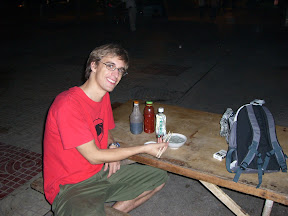
On the way back from Fuzi Miao the other day, I stopped for a delicious and cheap meal of jaozi, which are essentially small meaty dumplings. It cost 1RMB, ar about 0.07 GBP. The guy cooked seven for me and served them. Boiling hot meaty goodness is fantastic after a hard afternoon's browsing at the market. For table service on hot food cooked to order, it doesn't get much better!


The bottles you can see, from left to right, are:

  1. Soy sauce - mandatory with this food! It's good!
  2. La 辣 - a chili sauce that's very popular in Nanjing and most cities in north China - only to be used in moderation until you get used to it, I reckon
  3. My wheat drink. It's like a tea drink, only wheaty. Tastes refreshing, and a bit like wholemeal bread.


Yes, I had a haircut shortly after this photo was taken.

Monday, December 04, 2006

Sugar Dragons

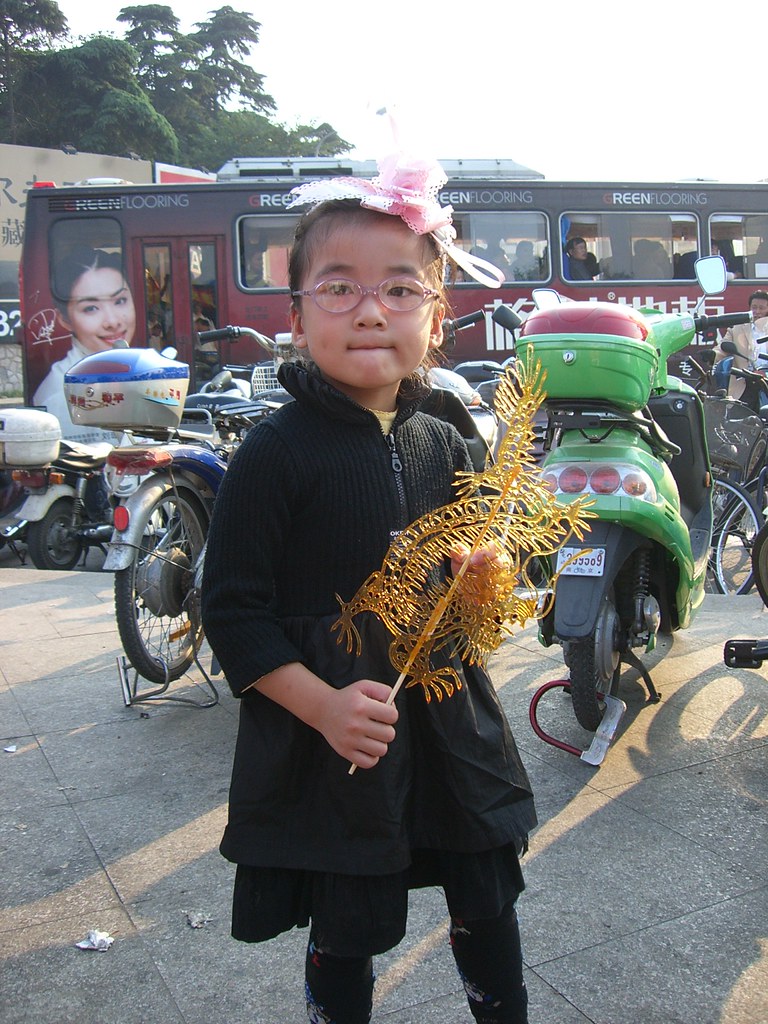
You can get sugar dragons made in front of your eyes here! While visiting the nearby lake, we found a small market, selling all kinds of unusual goods; skinned coconuts full of milk, deep fried scorpion, fresh Muslim lamb skewers from the far west, and sugar dragons!

A practiced Chinese gentleman will produce a board stuffed with little paintings with a spinning pointer at its centre, and ask a child to spin it. The pointer will land at an animal or object. The gentleman will then proceed to take a ladle of special syrup and whizz it over a smooth marble slab, flattening the sticky things he draws with a special metal tool when needed, where it quickly hardens into a detailed edible sugar dragon! Or a phoenix, or a bicycle, or anything! When the model's finished, he sticks it to a stick, and gives it to the child, who will parade it around for a while, and then quickly gobble it all up. It's fantastic!


Sea of Bamboo

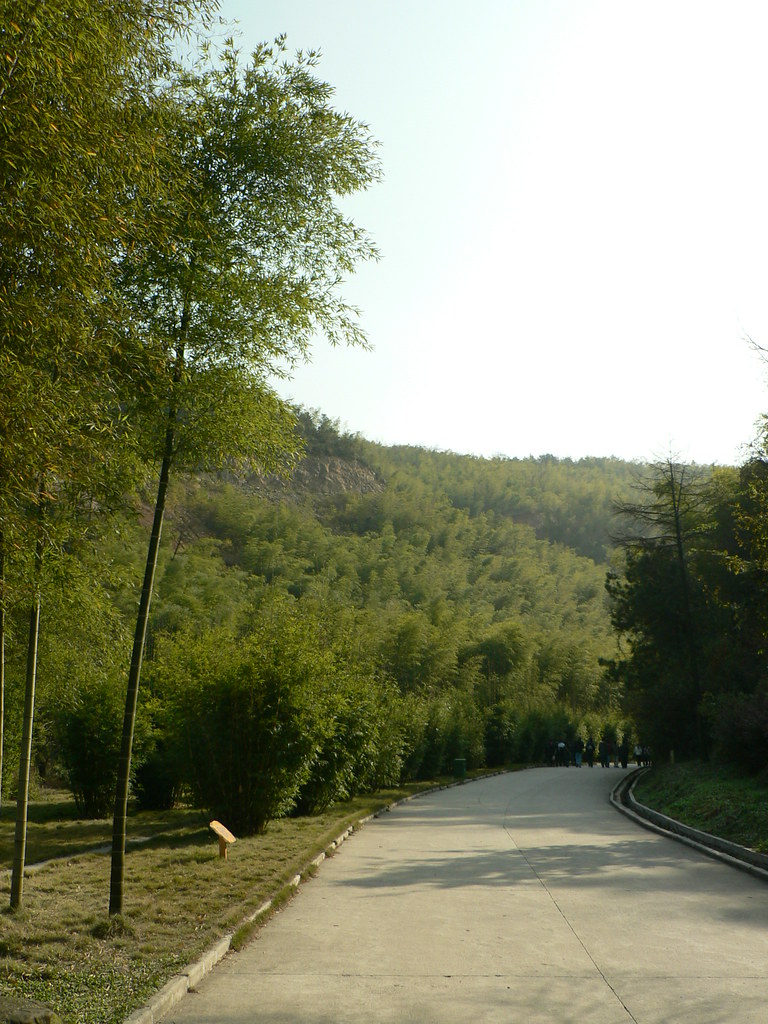
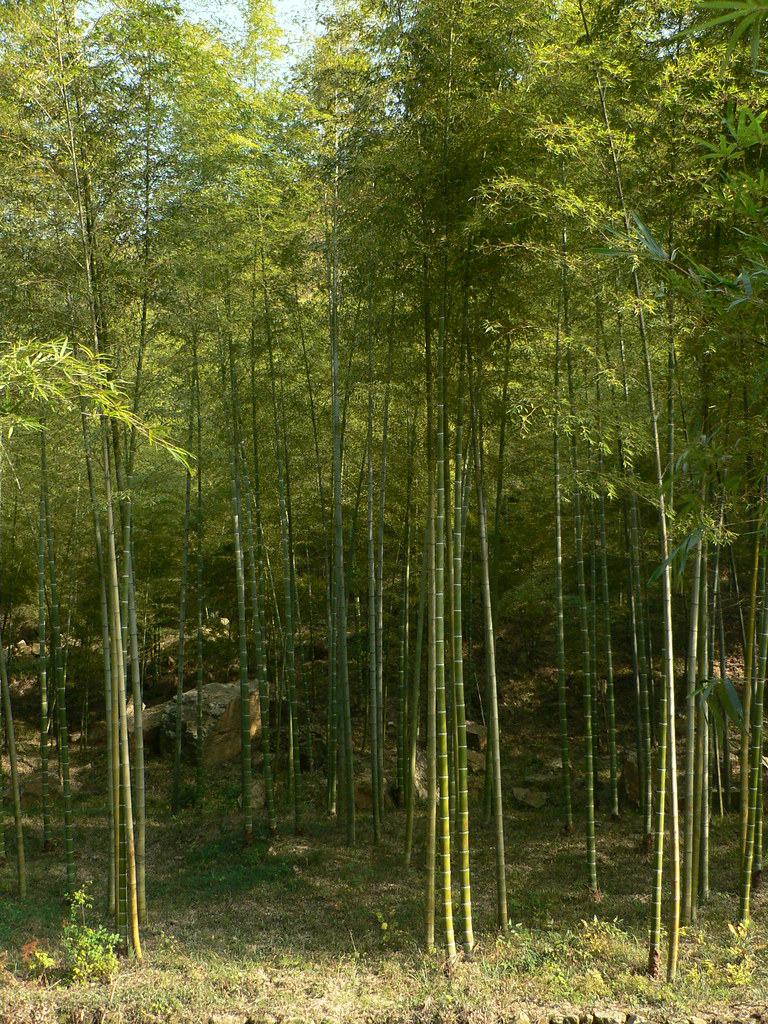
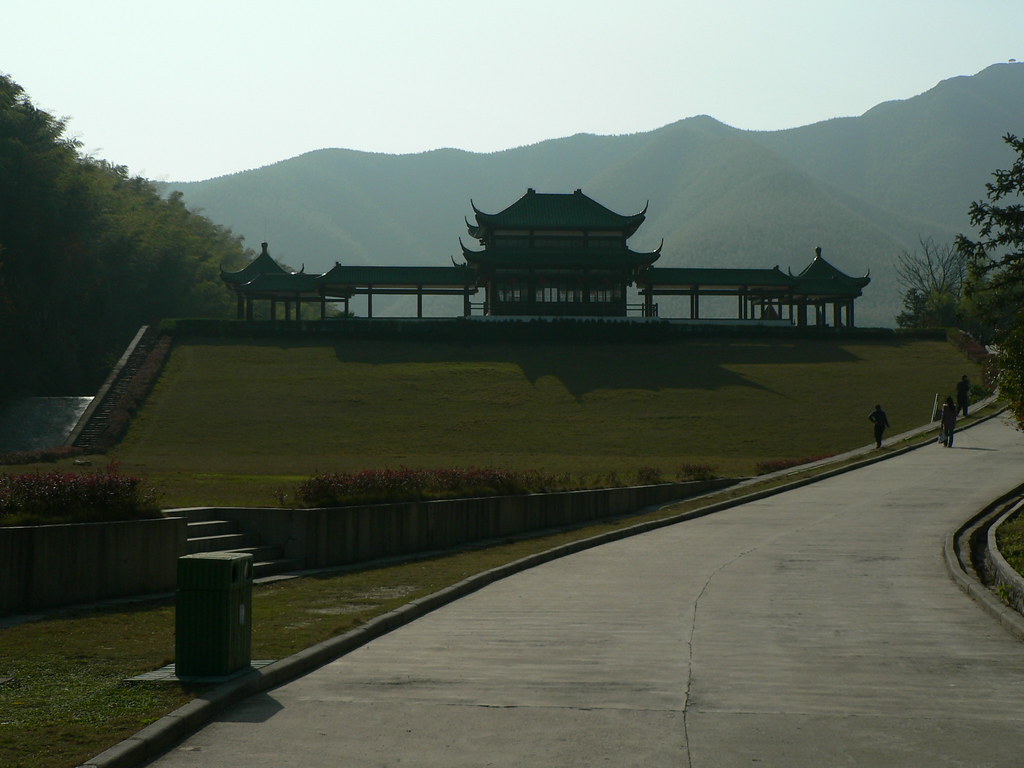
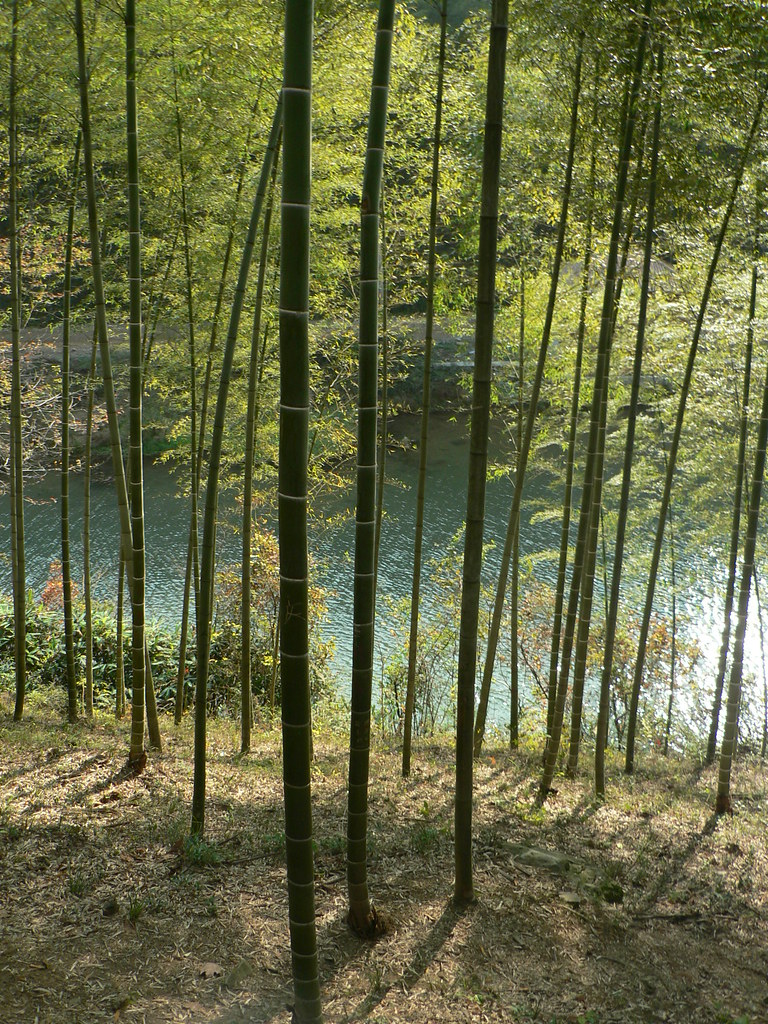
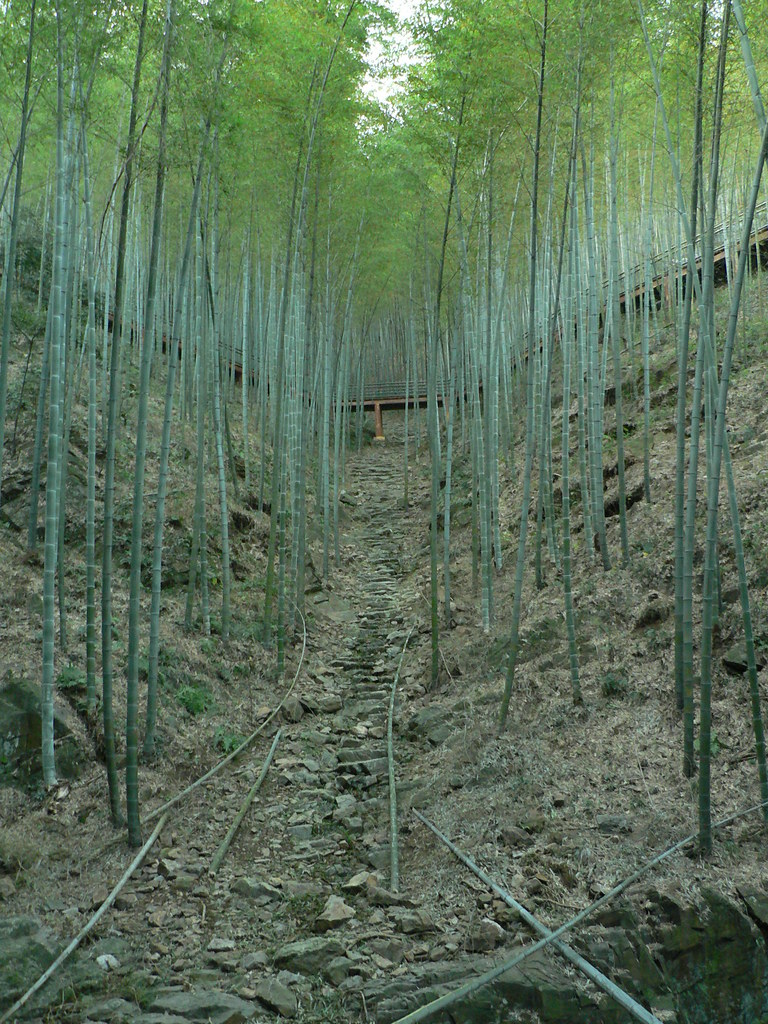
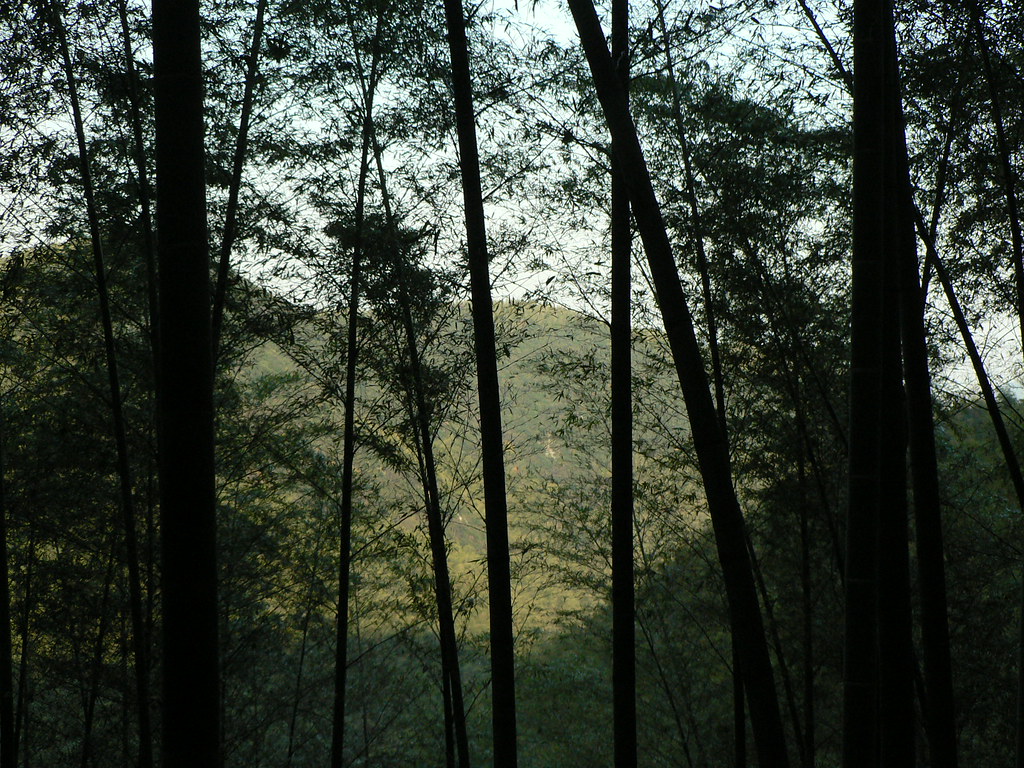
The Sea of Bamboo is a large natural forest of bamboo near the town of Yixing, Jiangsu. We visited it with a class from NUAA. It's a sight just like you'd expect from any cheesy brochures of China, or perhaps - more gratiatingly - high budget Chinese gong fu (kung fu) films; hordes of gently bowing white-ringed bamboo stalks, crowned with a handful of tiny spring green leaves, for as far and as deep as the eye can see. The Sea is tastefully accomodating to tourists, thanks to a plain wide path that leads through it, turning into stone steps or even a bamboo walkway at points.


The path in


Green bamboo

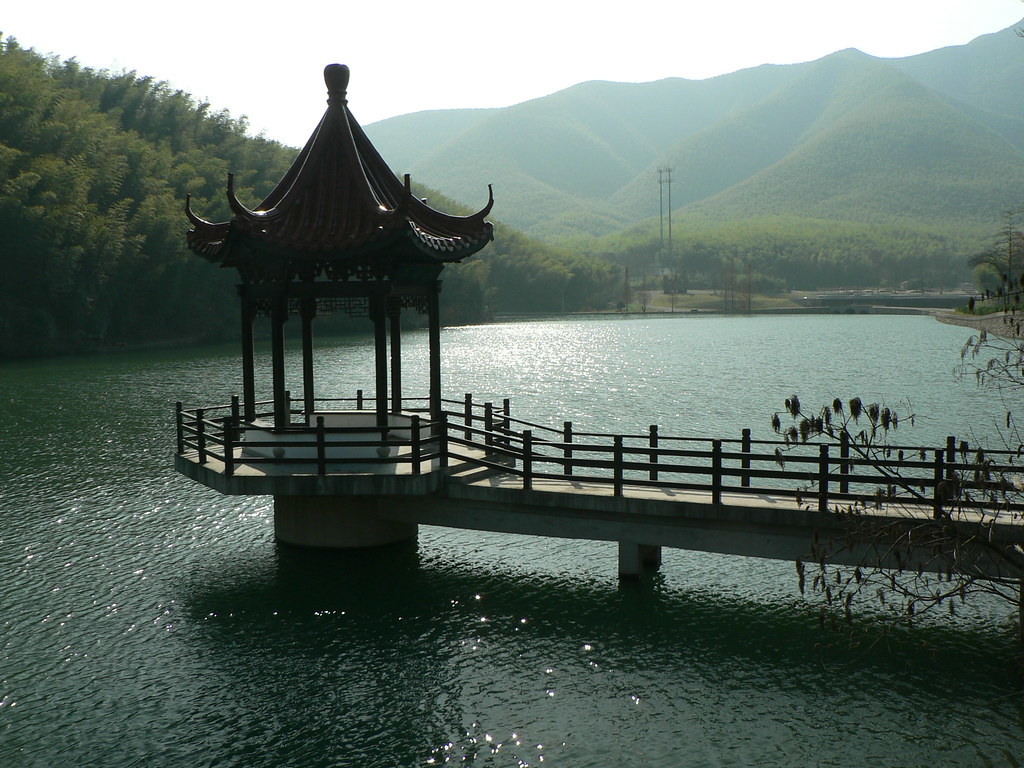
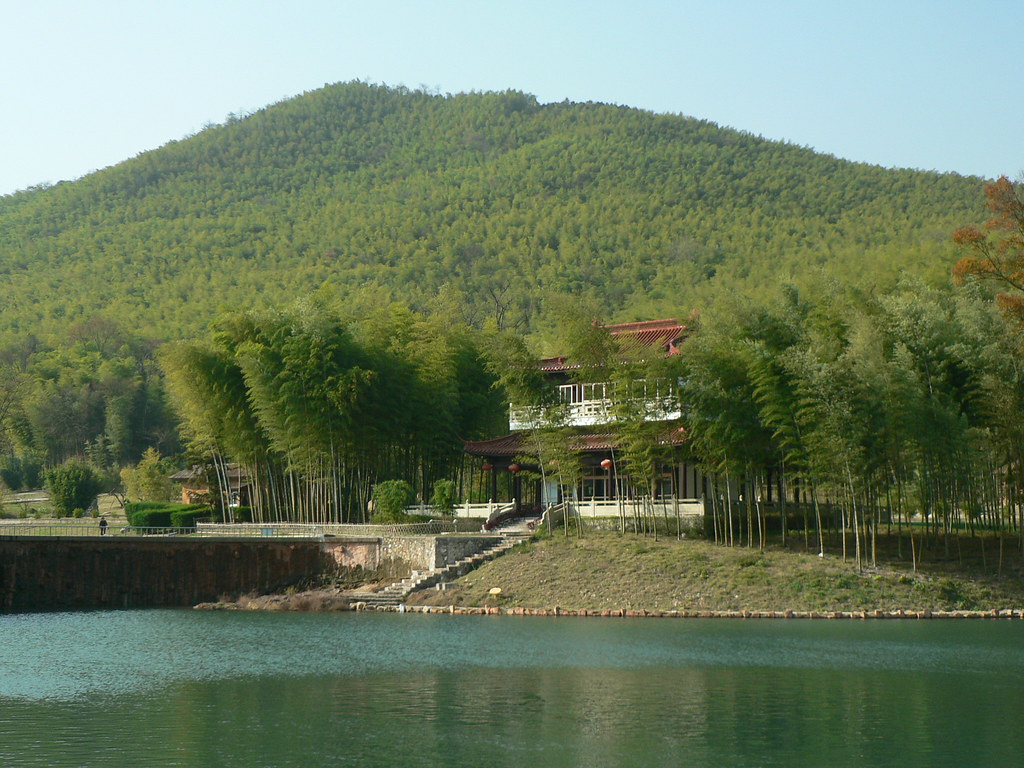
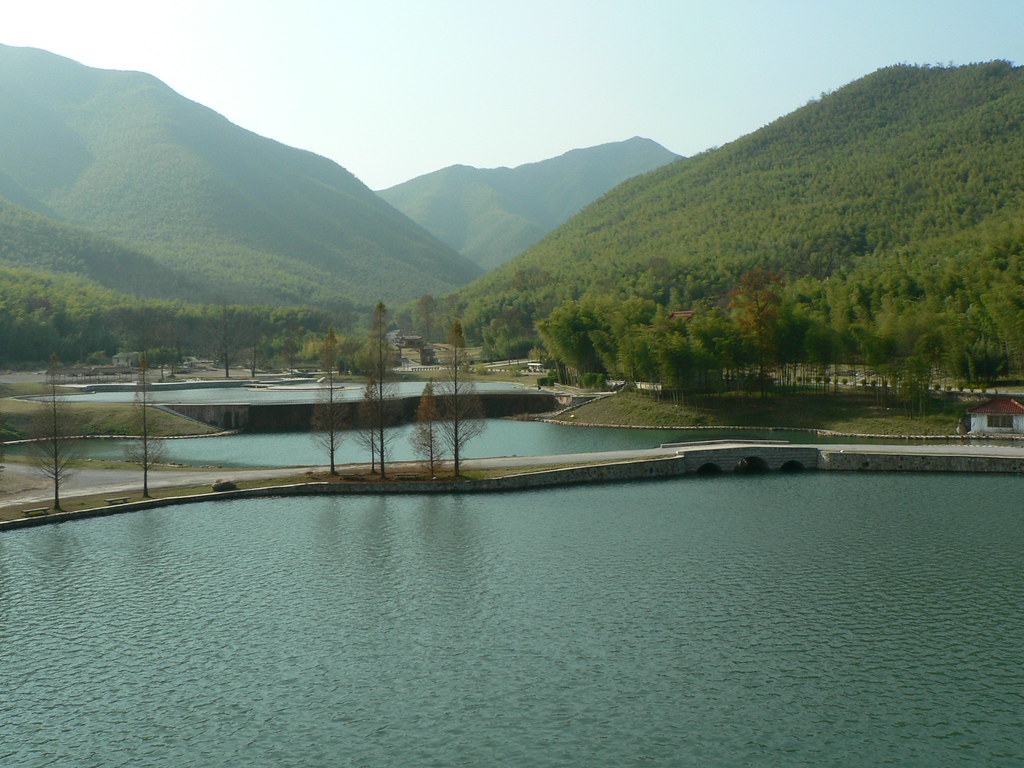
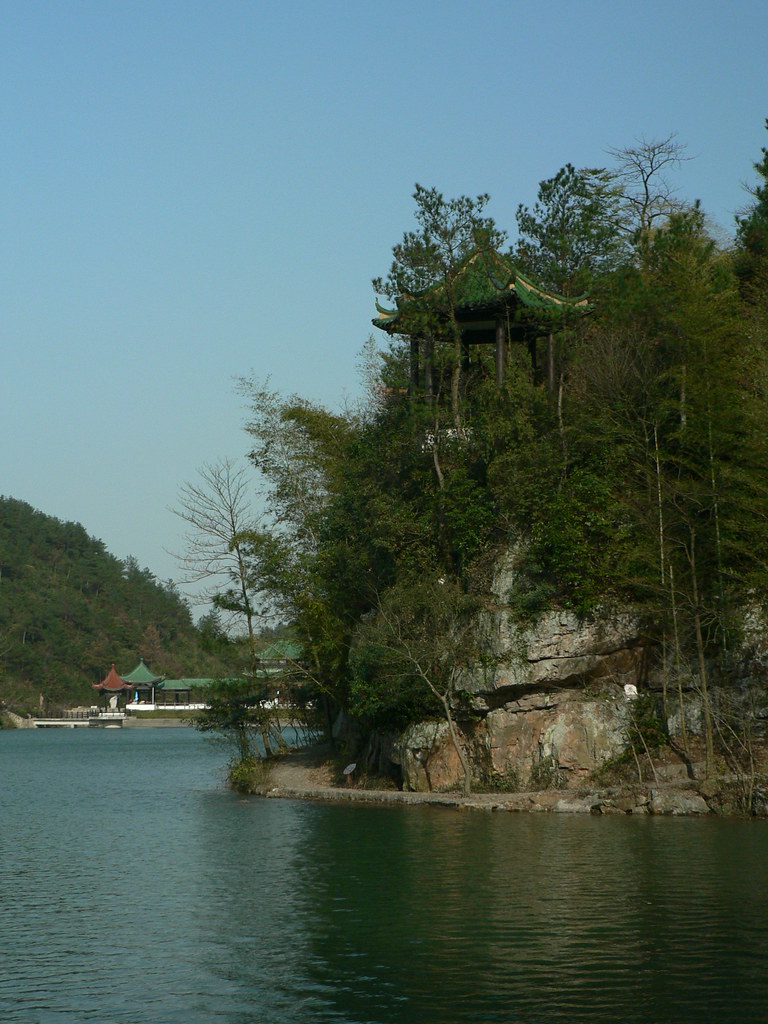
The first great sight along this path is a very traditional pavilion at the top of a small grassy slope. Backed by photogenic rolling mountains which have just enough mist to highlight their creases, it's the perfect prelude to the next sight - Mirror Lake. This area is well tended to, and very clean and calm. On the other side of the lake is a series of small lakes and dotted trees, which can be seen while walking round the long way. If you go the short way, there's a traditional pagoda to relax in. If you're adventurous enough to climb the hills around the lake, there's a cute viewing platform hidden in the trees, offering a panorma of the area, and perfect for a quick kiss.


Pavilion


Mirror Lake


Pagoda shrouded in bamboo


Higher parts of Mirror Lake


It's steep from the top!


Viewing platform

Further along, the path climbs upwards into the mountain, all the time surrounded by bamboo plants. People love to carve their names or some words into the trees, or even just draw in the powdery dust which accumulates on the trunks. This continual flow of vary shades of green is occasionally punctuated by an ancient temple, cave entrance, or stream. And also a children's playing park, which was good fun! It's around 7km from the entrance to the summit, depending on which route you take. The air here is extremely good, especially compared to urban stuff, and it's a very serene place.


Cave entrance


Mountain stream


Rough path up to the bamboo walkway

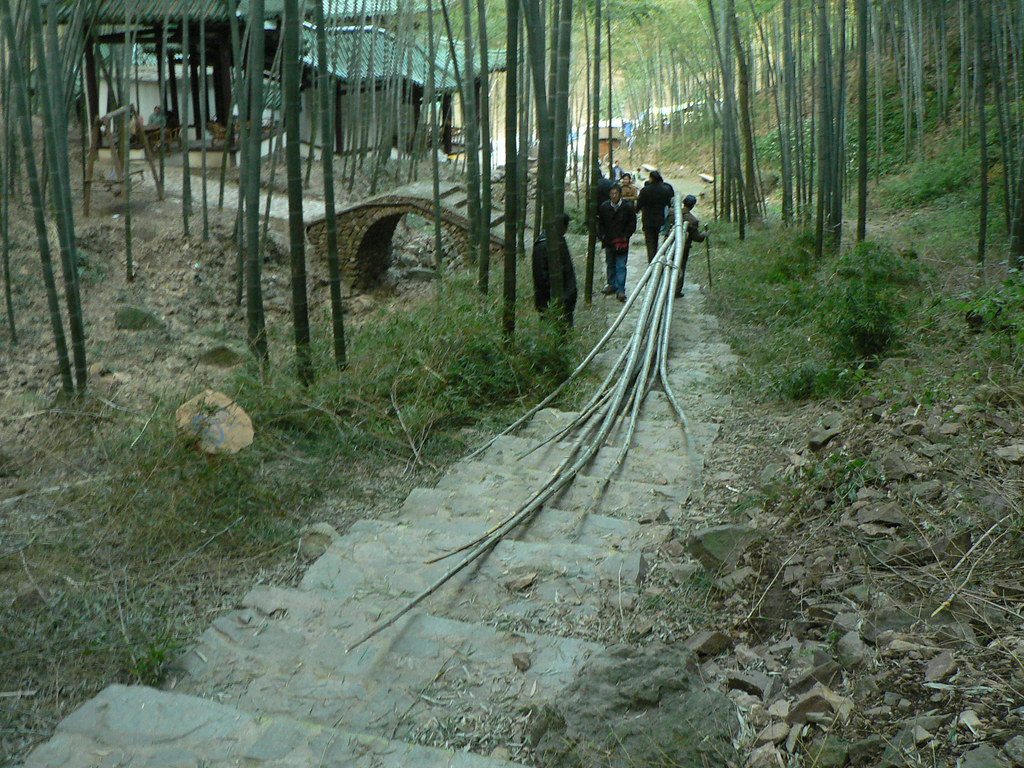
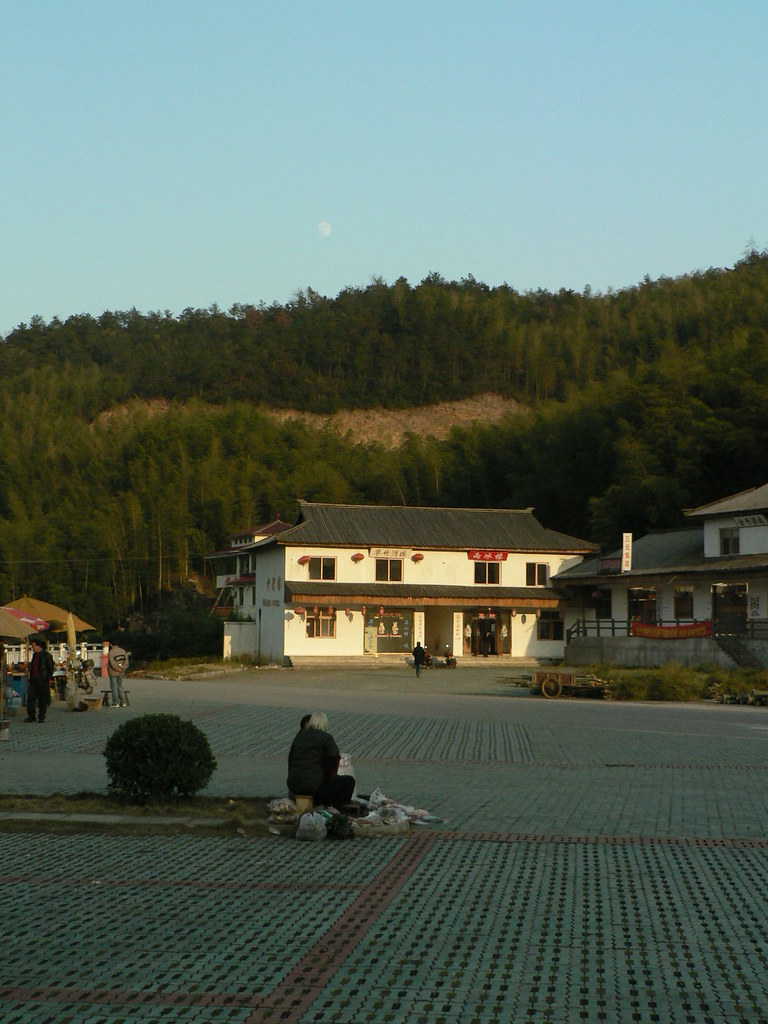
After a little while, we came to a resting place that was the base of the climb to the summit. The trail turned to steps here, and there were workers dragging trunks of harvested bamboo down the paths (perhaps to be used as scaffolding, who knows!). It was hard work, though the climb was worthwhile. We took the bamboo walkway down, and then hopped onto an electric tour bus to get to the front gate, so as not to miss our ride home. The moon had risen just as we were leaving, giving a glorious glow to the mountain at the end of the day.


Bamboo fronds at sunset


Carrying trunks down the steps


View from high up


Thoroughly recommended!

Yixing

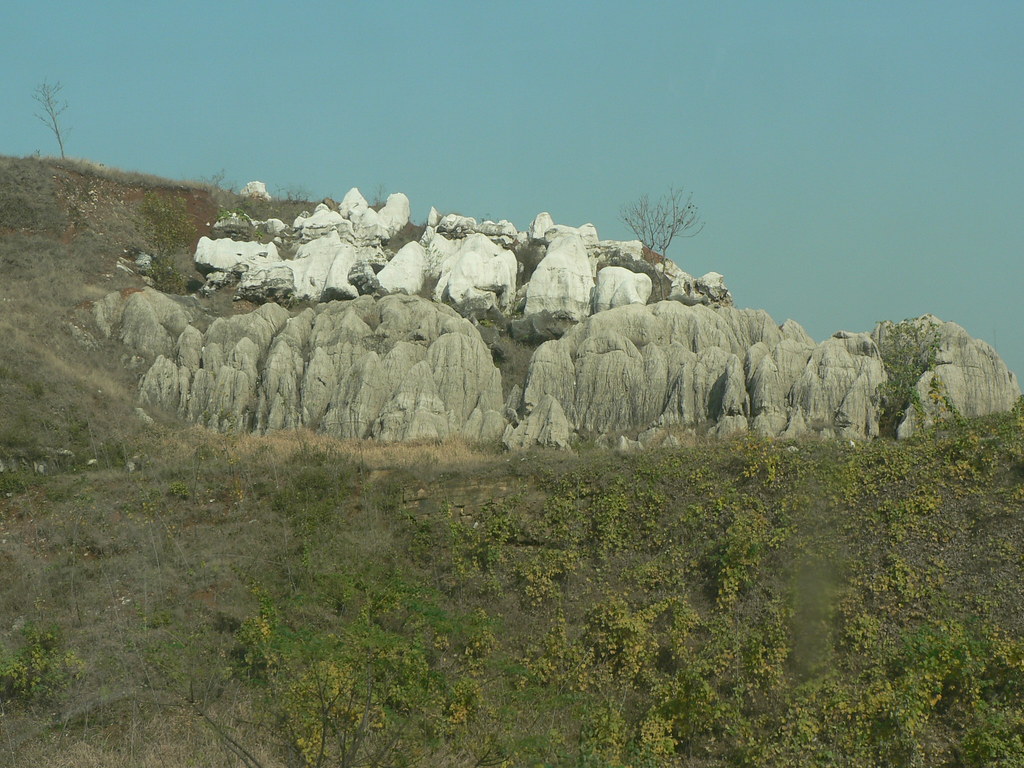
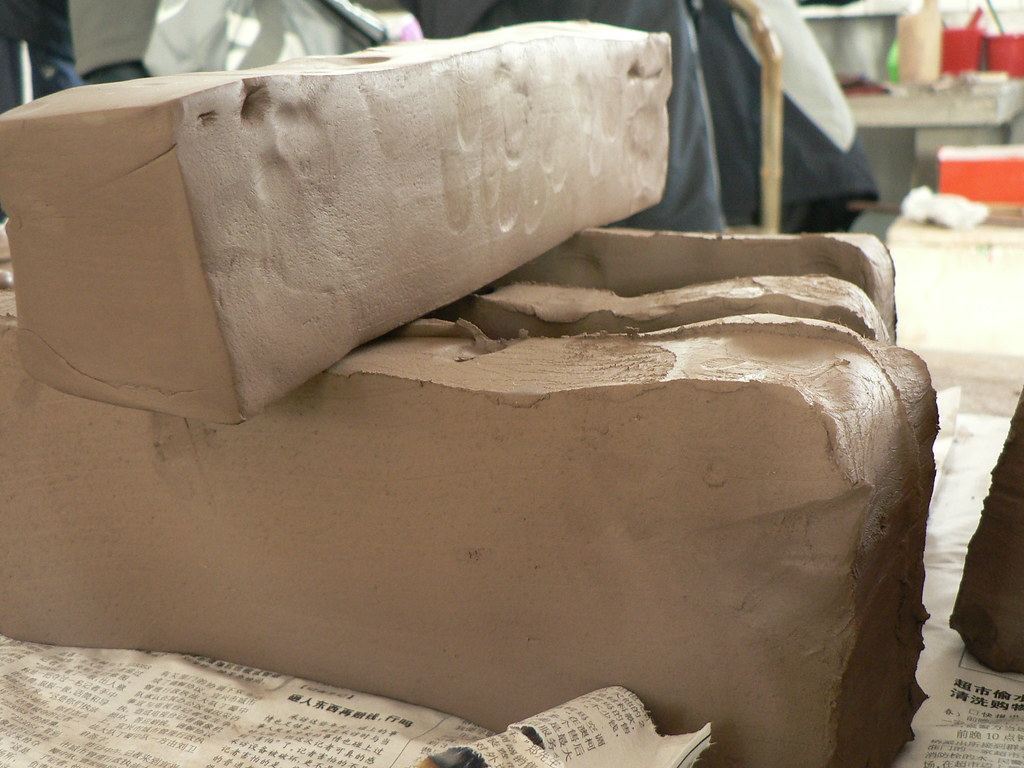
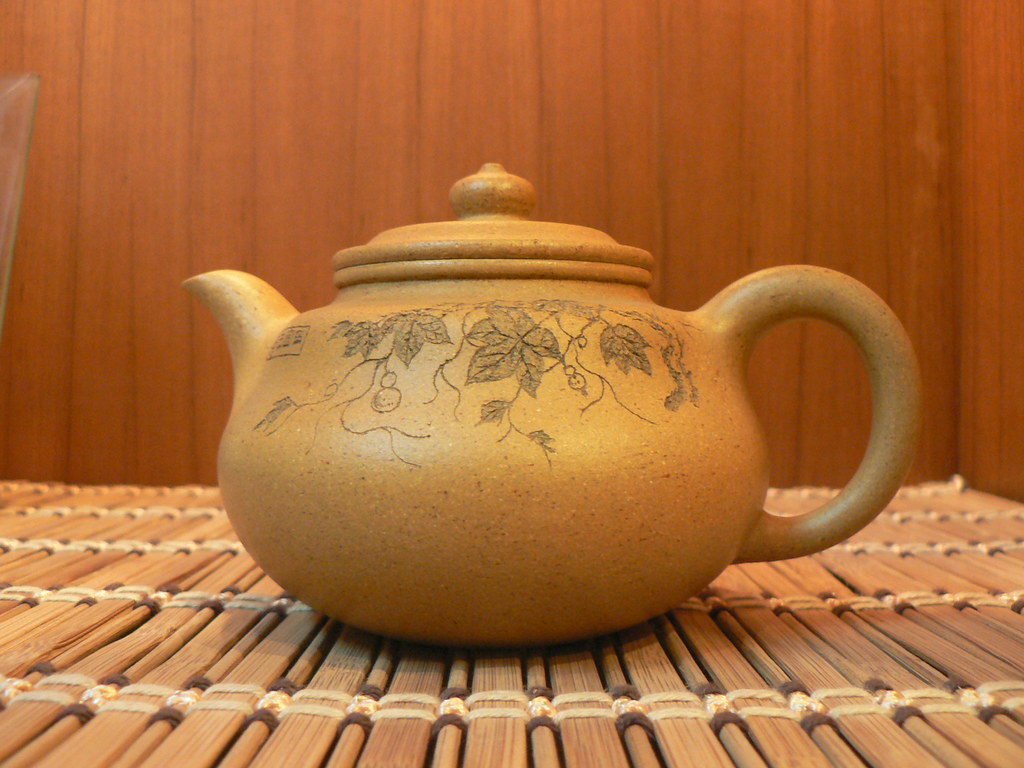
Yixing, in northern Jiangsu province, is known throughout China for its dark clay. Many local businesses revolve around manufacturing earthenware goods from Yixing's "purple sand", either via mass production or by hand. Often, Chinese artists who work with clay will build their pieces out of material from this region.


Yixing clay


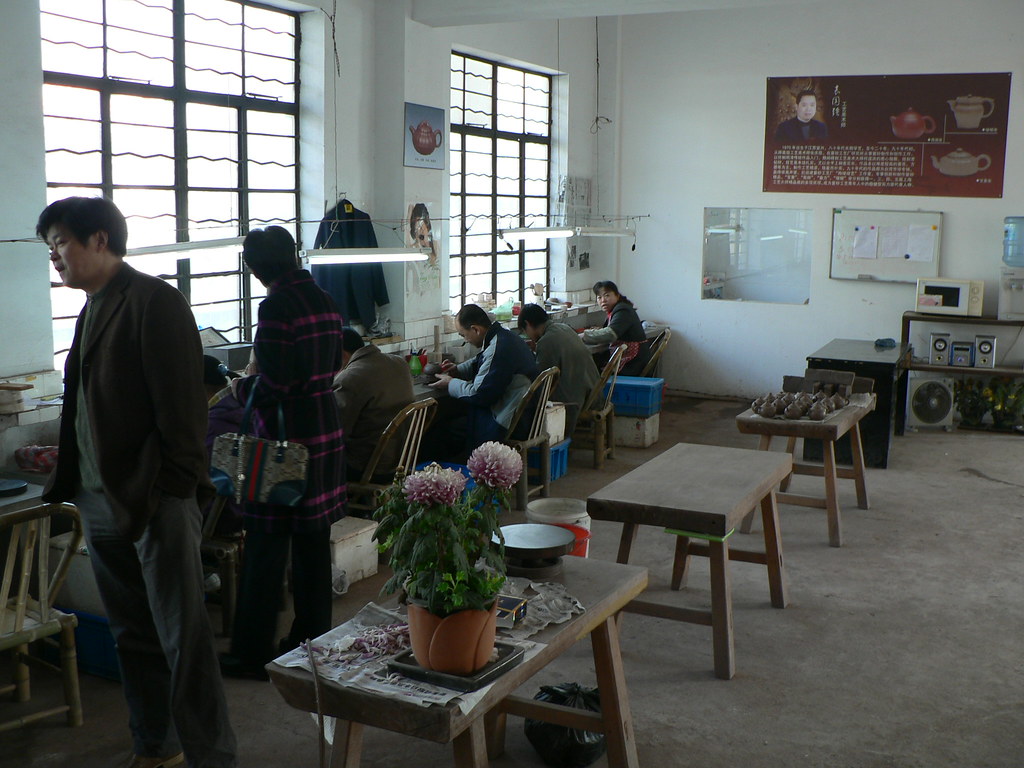
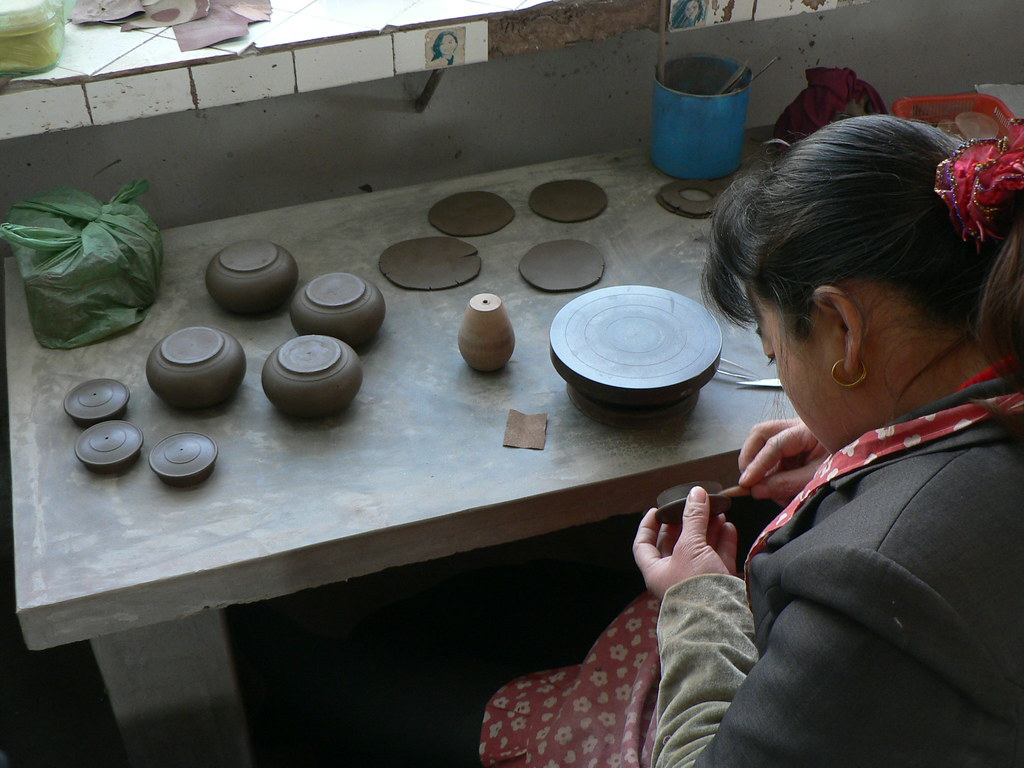
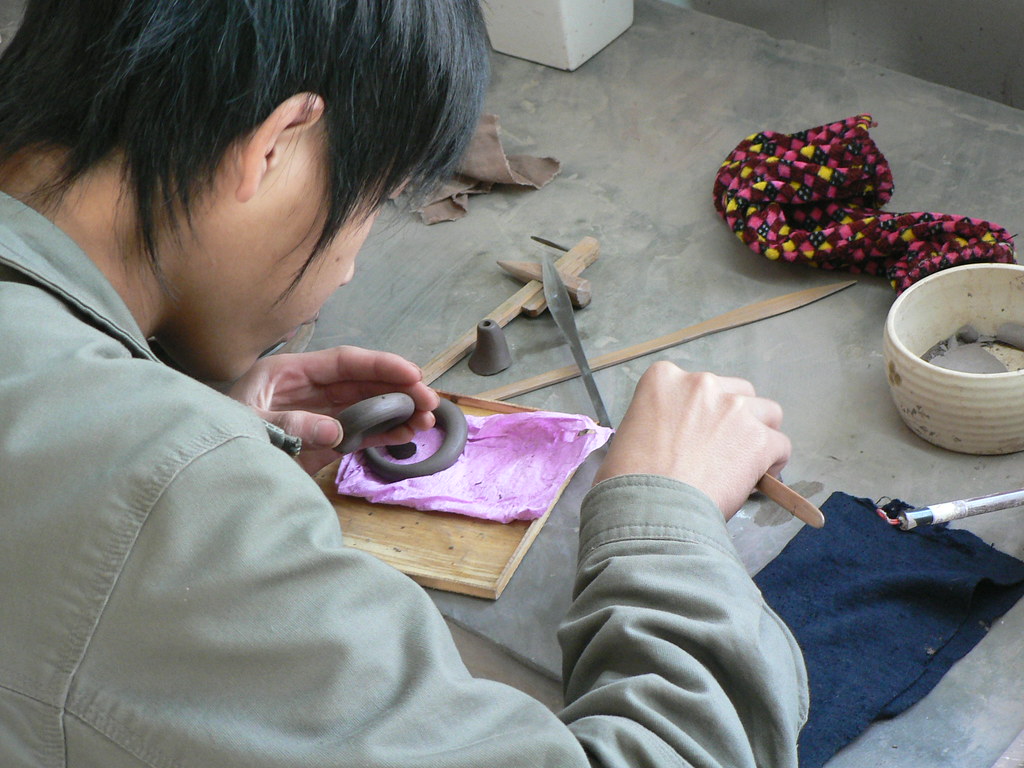
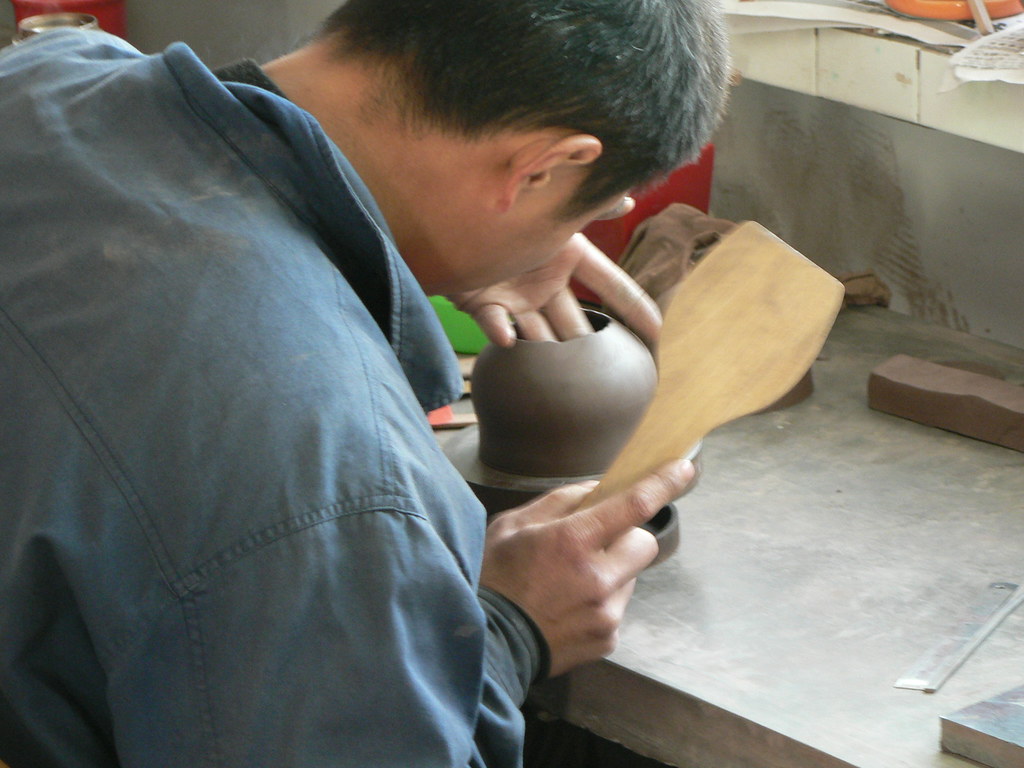
We visited a teapot factory in Yixing, where people meticulously put together very high quality hand-made clay teapots.


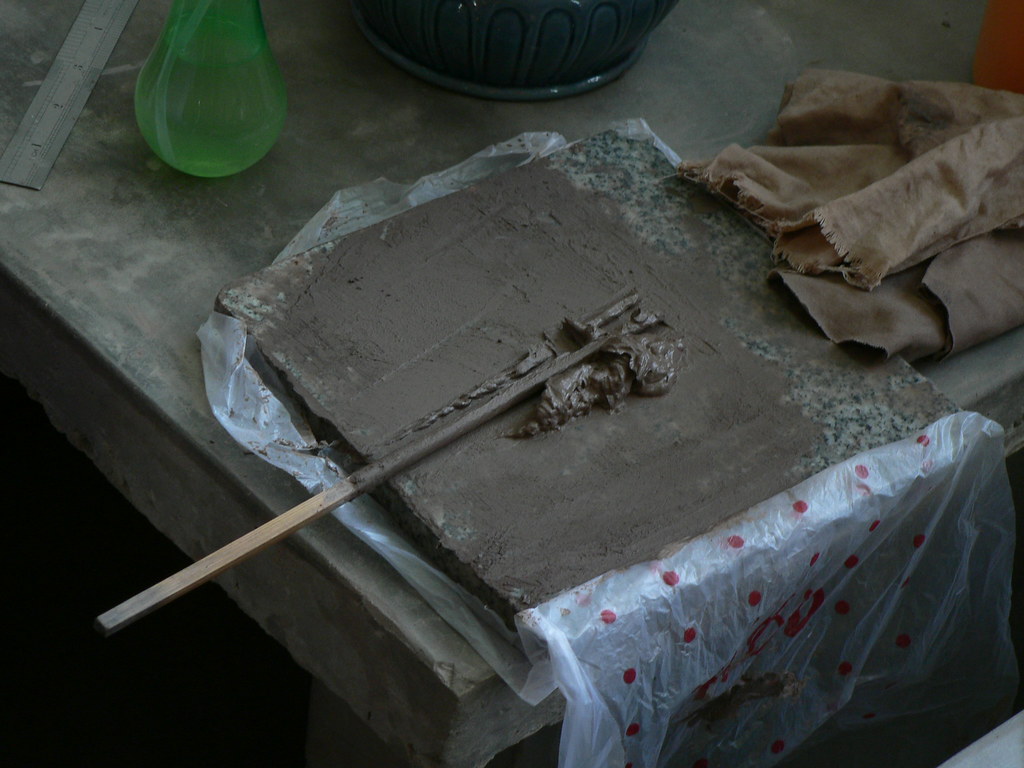
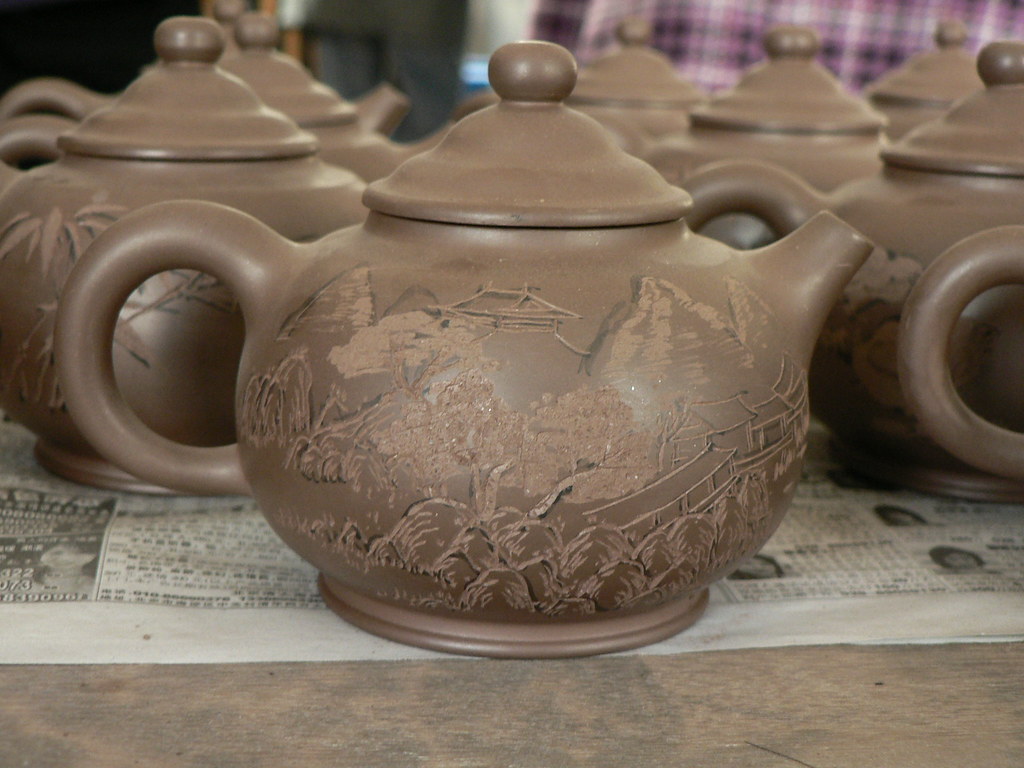
Each person will work on a different piece of the teapot - the spout, the handle, the base, the lid, and the main chamber. The work is very fine - despite making the walls of the teapot only 3 or 4 mm thick, the artisans manage to keep every part perfectly round and well formed. The end product looks as precise as a machine-built item could be, without manufacture marks.


Wet clay, ready to be smoothed in


Smoothing the teapot


Finishing the lid


Making the handle


Carving a spout


Thinning the chamber walls


The finished product

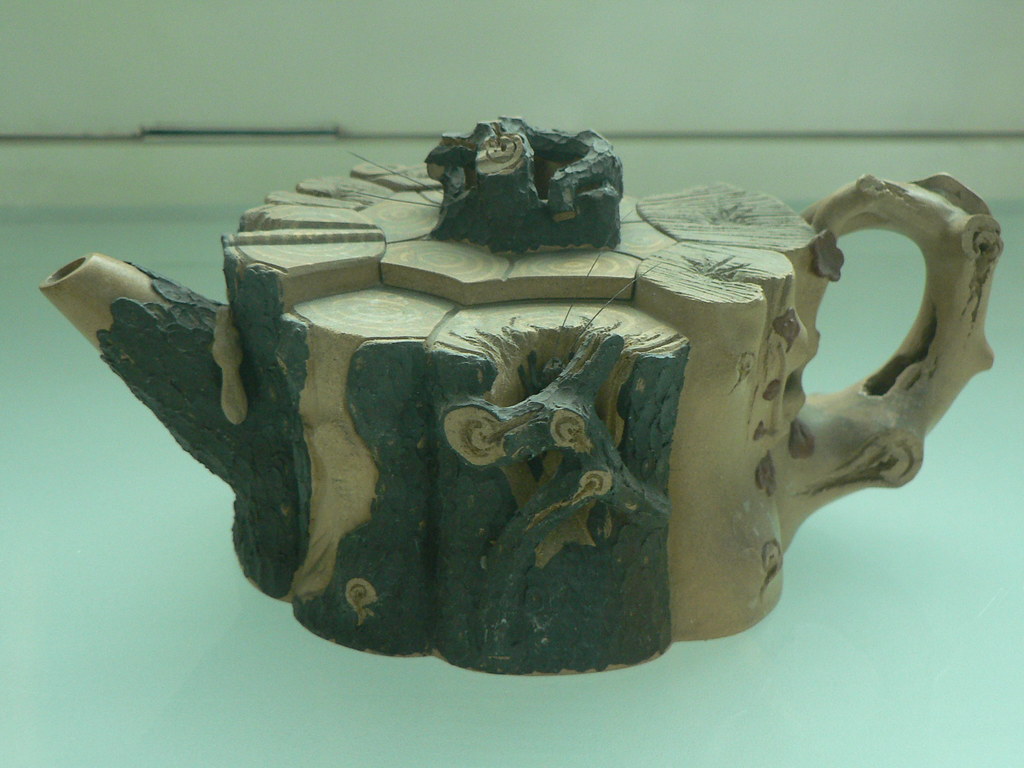
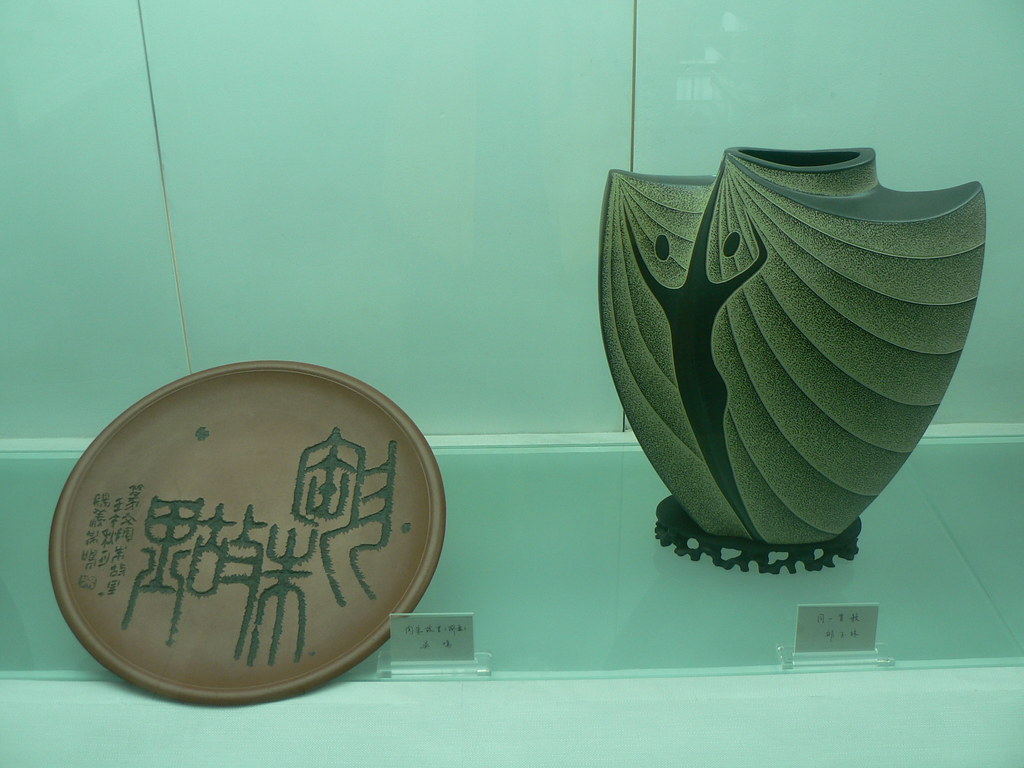
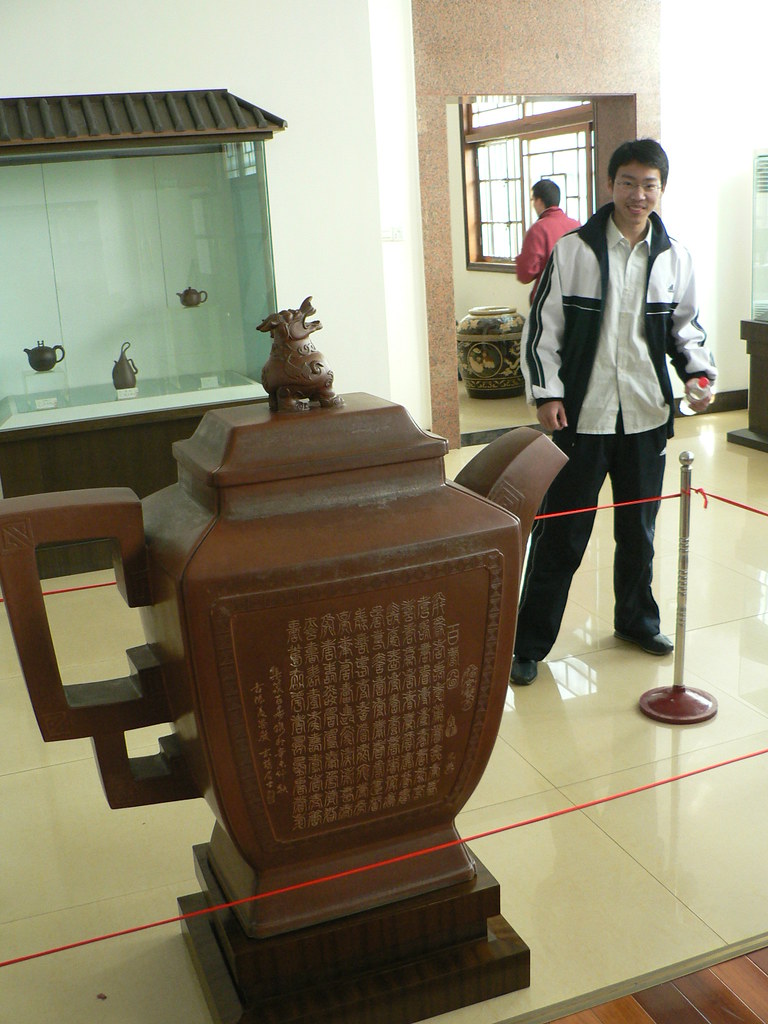
On the ground floor of the factory is a small museum of teapots and tea sets made with Yixing clay by famous arists. Many are worth over 1 million RMB; for comparison, that's 100 000 Euro for a well-crafted and simple teapot.


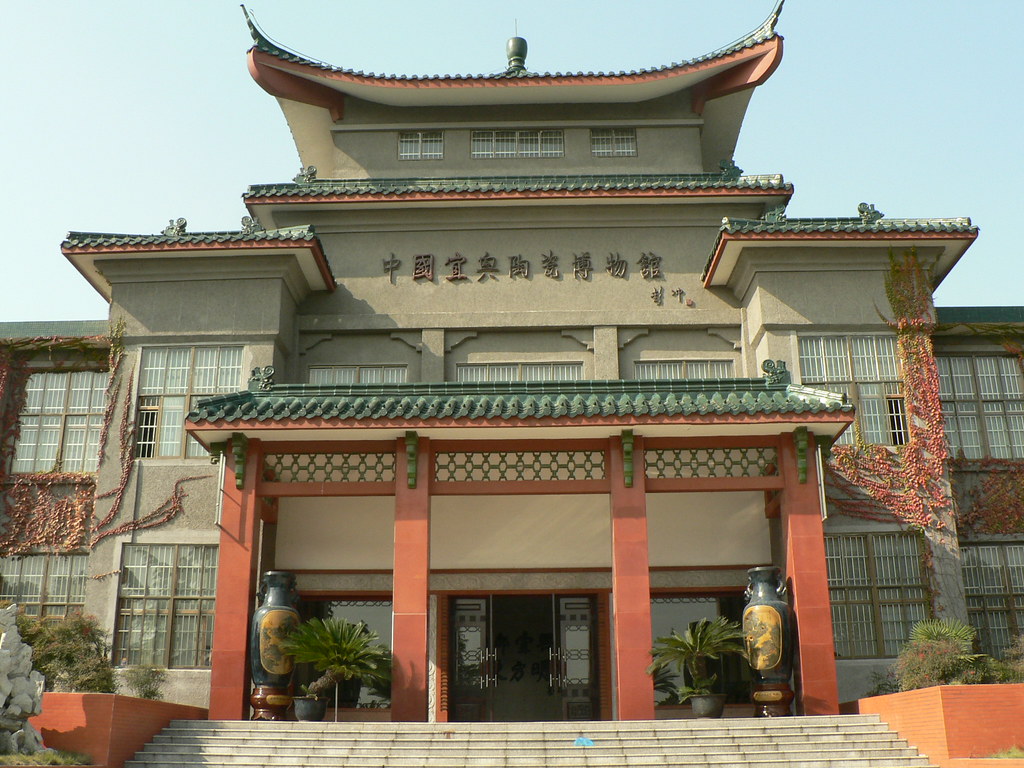
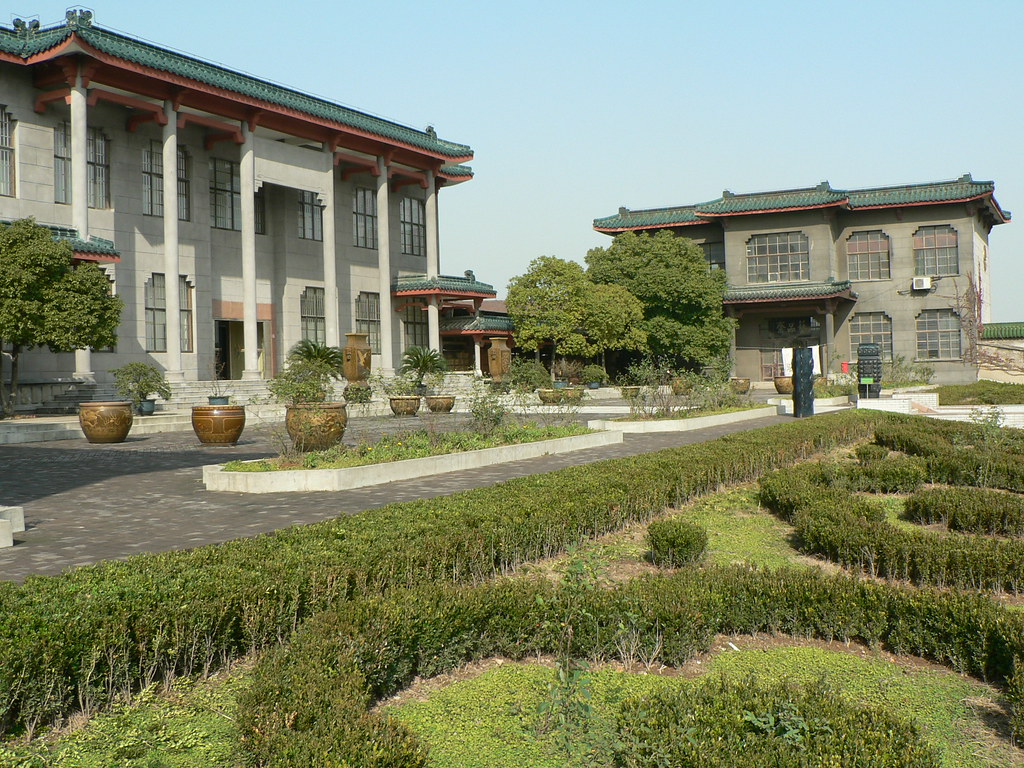
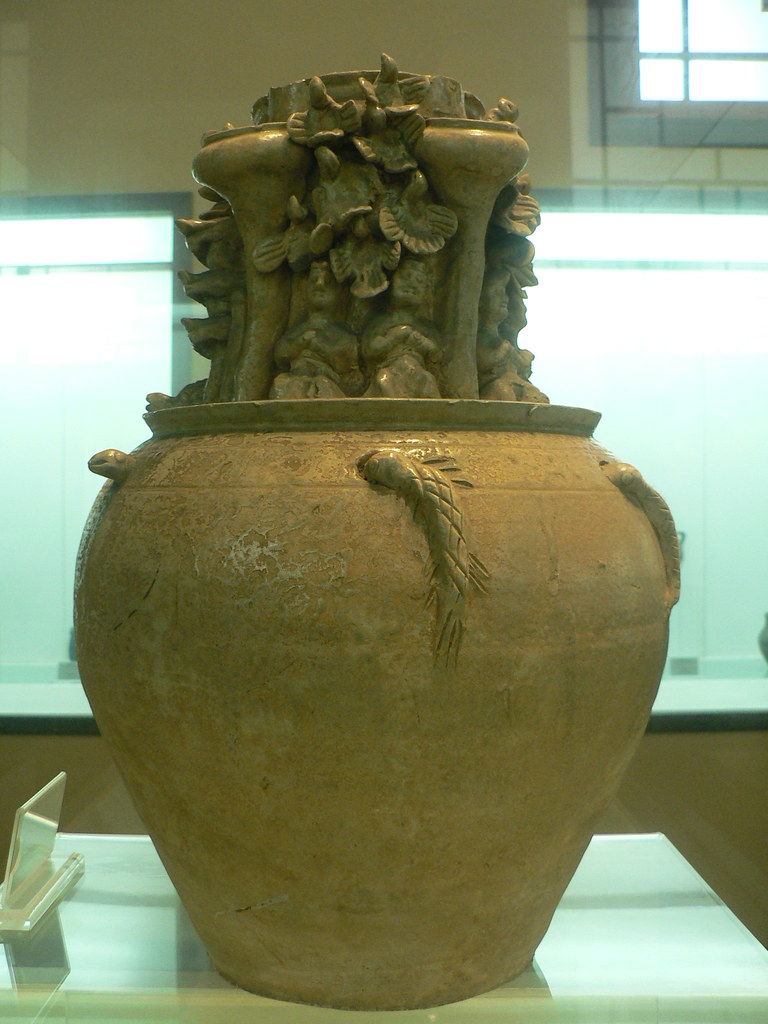
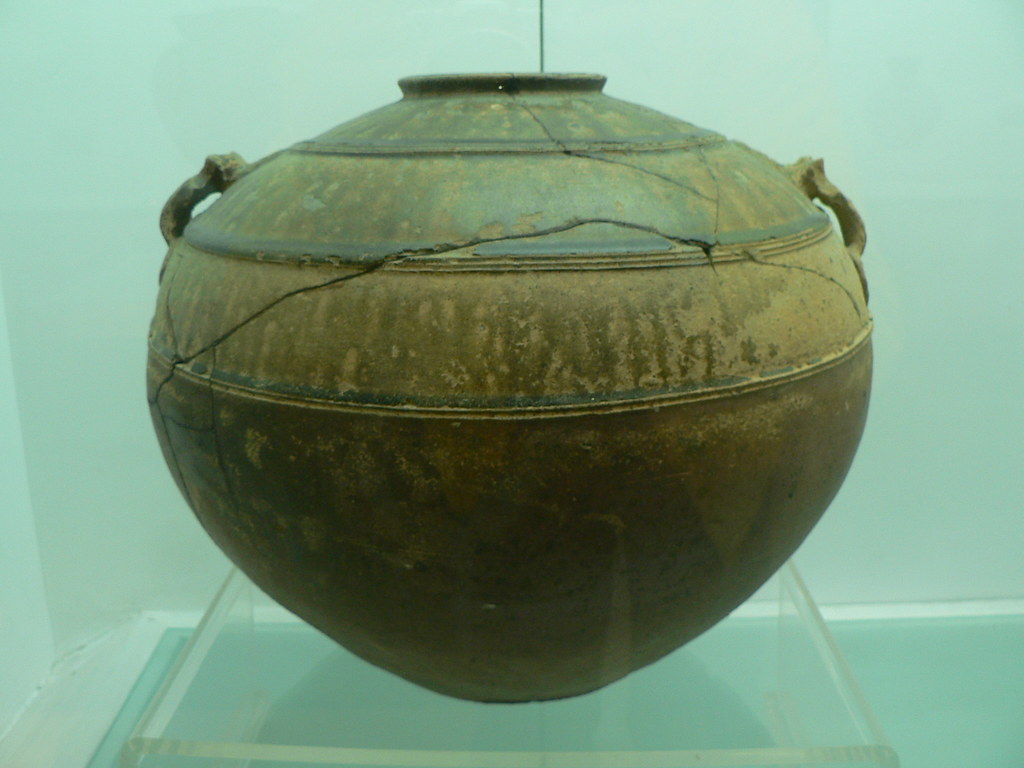
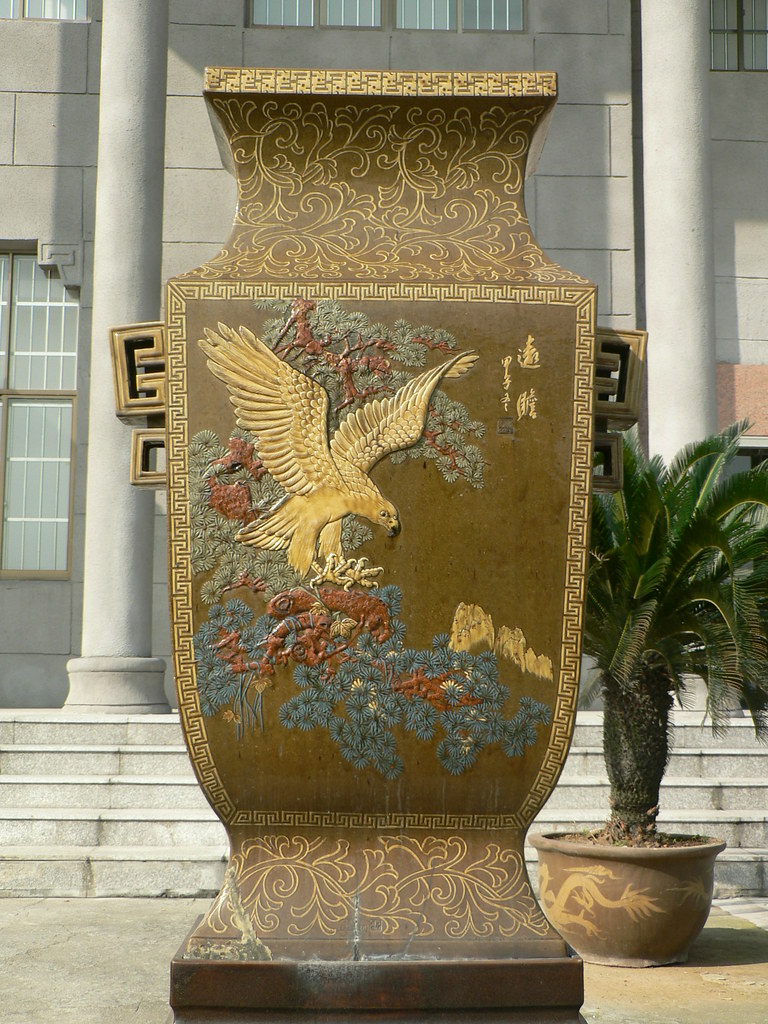
As well as a swelling pottery and glazing trade, there's a museum of pottery, containing a lot of ornate and interesting designs (mostly teapots!) in Yixing. There's some ancient pottery here, much older than most European countries, and also many beautiful exhibits of royal and modern earthware products.


Yixing pottery museum


There's a fantastic huge bowl of heavy clay made for Emperors of the Ming Dynasty, whose is coloured a beautiful deep ivory tone and textured like large scales, topped by a green rim, over which lies a translucent sea green glaze. The full name is something along the lines of "Lotus Flower Dragon's Head Bowl". Unfortunately no photos were allowed here!


Around 200 years old


2000-3000 years old


Relatively modern, and huge (~2m)

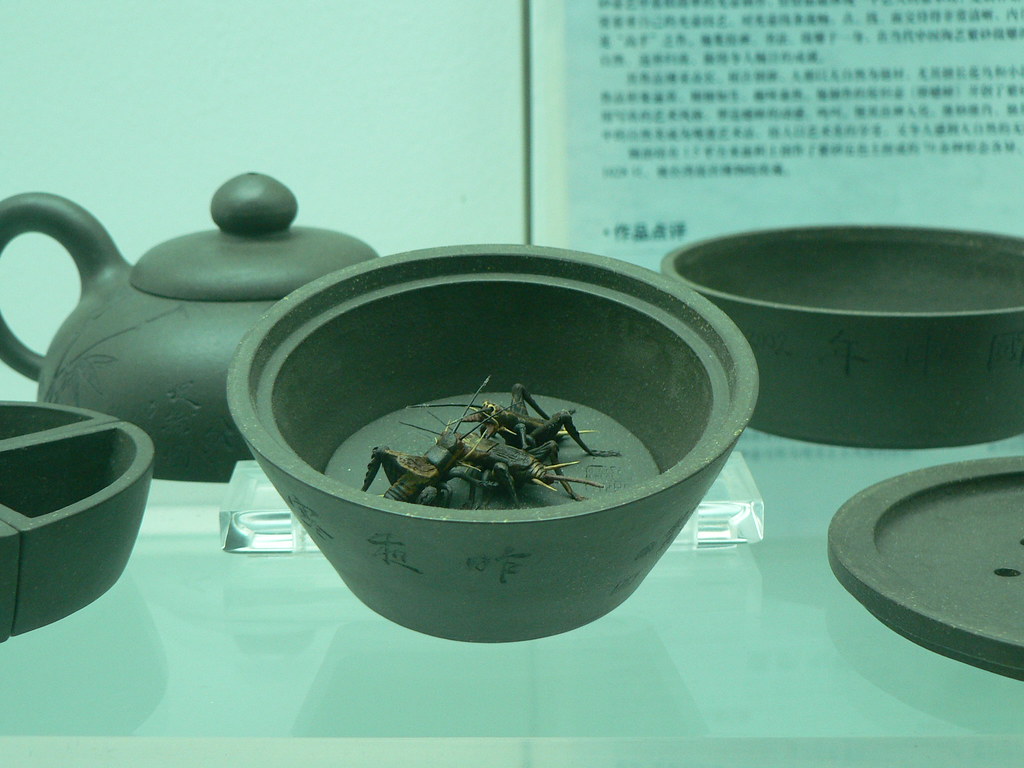
One very popular adornment to the teapots and the like we saw in Yixing is the inclusion of an old fighting beetle. I'm not sure of its English name. Men would place bets on their beetles, and whoever's beetle survived the fight would collect all the cash. There were also some very non-traditional looking pieces here, that could easily pass in any modern collection worldwide.


Yixing is also well known for its black rice. It's sticky, like most Chinese rice (imagine picking up grains of dry rice with chopsticks after a hard day's work!), and served with sugar. It's really delicious and goes well with most food. The tangy juices left by any even vaguely spicy dishes can be mopped up with sweetened black rice to make a very enjoyable mouthful! Around 4-7RMB for a 250g bag.

It's easy to collect pieces of purple clay Yixing pottery from any of the local dealers that crowd town; expect to pay about half the inital price offered. A 15cm long plain teapot goes for about 20-35RMB, with prices going up alongside size, as you'd expect!

If you're interested, you can pick up some genuine Yixing clay:
Antique Yixing teapots for sale
Cheap Yixing teapots